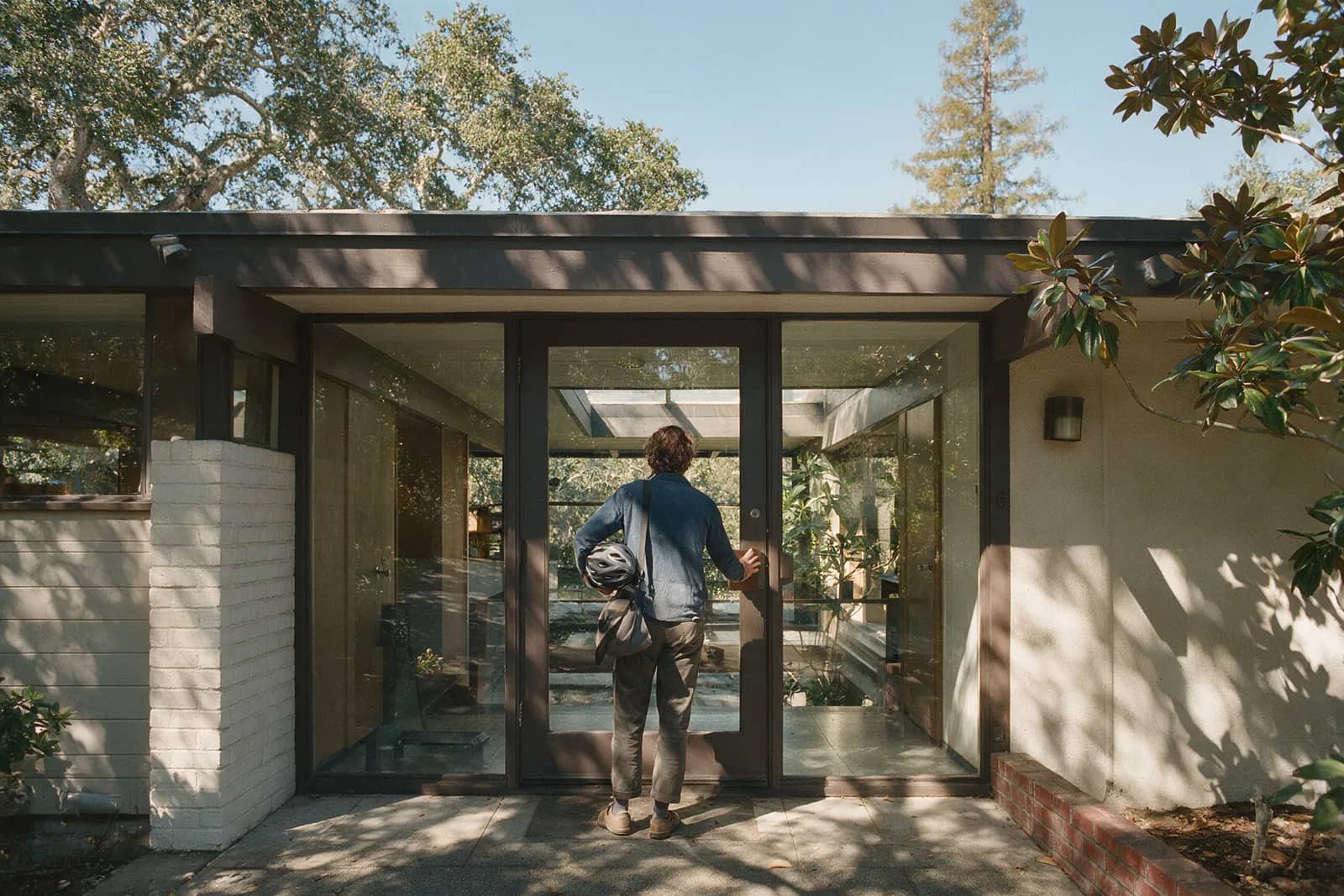
What is inside the edge of the door
Stand on a Professorville porch and look at the edge of the front door while it is open. There is a brass faceplate about six inches tall with two openings, a beveled latch and a square bolt. Behind that plate, in a pocket cut into the door in 1915, is a mortise case: a steel box holding the latch, the bolt, a spring for each and a hub that the knob spindle passes through. On the face of the door is the plate with the knob, a keyhole shaped for a bit key and, on the inside, a small thumb turn that throws the bolt.
Above the knob on the inside face is the second lock, a rim latch screwed on decades later with a pin cylinder showing on the outside of the door. It was added when the family stopped believing the bit key would keep anyone out, and they were right not to believe it. Both locks still work after a century, more or less, and the owner has usually lived with the less for years: a knob that turns a little too far, a bolt that needs the door lifted, a bit key that lives in a drawer and has not been in the keyhole since the 1980s.
Which part is actually locking the house
The rim latch, and only the rim latch. The bolt inside the mortise case is worked by a bit key against wards, which are fixed obstacles rather than a code; a bit key of the right size and shape passes them, and blanks that fit most of them are sold openly. The mortise bolt is a courtesy, a way to hold the door shut on a windy night. The rim latch has a pin cylinder, and that cylinder is what a key from a pocket opens and what a stranger cannot.
So the first job on a Professorville door is not the beautiful part; it is the cylinder in the rim latch. It is rekeyed at $27 to $45, which retires every key that went out over forty years to a neighbor, a nephew and the man who came about the furnace. Nothing on the face of the door changes. Where the rim latch itself is the 1950s pattern with a short bolt and a strike held by three-quarter-inch screws, a modern rim deadbolt of the same footprint goes on the inside face, uses the same hole through the slab for its cylinder, and throws a full inch into a strike screwed to the framing. That is a replacement at $125 to $329, and from the sidewalk the door has not changed at all.
What is repaired with the plate on
Most of what has gone wrong with the mortise set over a century is not the case; it is the spindle and the springs. The spindle is a square steel bar through the door that the knobs grip with set screws, and after ten thousand turns the set screw has worn a flat in it, which is the wobble the owner feels. A new spindle and a new set screw are fitted without the plate leaving the door. A knob that turns and does not bring the latch back is a spring inside the case, and the case comes out through the edge of the door, is cleaned of a hundred years of graphite and oil, gets a new spring, and goes back into its pocket.
What is not done is boring. A modern cylindrical lock wants a two-and-an-eighth-inch hole through the slab, and a 1915 door with a glass light and a mortise pocket does not have room for one without splitting. A locksmith who proposes it has not looked at the door, and that is said on the call from the description of the plate.
When the case is beyond it, and the parts that no longer exist
Sometimes the case has cracked at the bolt or the hub has rounded until no spindle will drive it. A modern mortise case fits the same pocket, and the original plate, knobs, keyhole and thumb turn go back on over it. That is a lock replacement at $125 to $329 per door, and the new case carries a real deadbolt worked from a modern cylinder, which retires the rim latch and the bit key together. The door looks as it did the day it was hung, and now it locks.
The difficulty on a door this old is not skill but supply. Spindle sizes, knob threads and plate spacings from 1915 came from foundries that closed before the war. Some parts are still made in the old pattern, some turn up at salvage, and some are gone. With the plate off, the technician says which is which and what can be done with what is there: a stripped knob pinned to a new spindle, a plate cracked at a screw hole braced from behind, a missing rose found or turned. None of it is guessed, and none of it changes the figure said on the call unless the owner agrees to something more.
Locked out behind a mortise lock
The lockout call from these houses comes from the porch. The rim latch was snibbed from inside, the door pulled shut behind someone collecting the paper, and the key is on the hall table. That is a house lockout at $129 to $219, and on a Professorville door it is picked every time. The rim cylinder is a pin tumbler and it yields to a pick and a tension wrench in a few minutes; a drill would ruin a cylinder that can be rekeyed for $27 and, worse, would risk the plate around it that cannot be bought anywhere. The bit-key bolt, if it was thrown, is passed with a bit-key pick from the van.
If the technician cannot pick the cylinder, which on these locks is rare, the choice is put to the owner in plain words: what would be drilled, what it would cost to replace afterward, and whether a window or a back door might be tried first. The figure for the lockout does not go up because the method changed. Arrival to Professorville is about eighteen minutes from Midtown.
The kitchen door, the gate, and a code for the caregiver
The front door is the one the owner cares about and the kitchen door is the one the house is entered through. That door usually carries a 1950s knob with no deadbolt, and the side gate onto the drive has a drop latch with no key. A deadbolt on the kitchen door at $125 to $329 and a keyed latch on the gate pinned to the house key do more for the house than anything done at the front. When an adult child asks how a caregiver or a cleaner gets in three mornings a week, the answer is a smart lock on the kitchen door at $189 to $479, with a code for each person that is retired when they stop coming, and the front door left exactly as it was built. A keypad on a 1915 porch is not offered.
Tall Tree Lock & Safe works to the Tall Tree Standard: the lock is picked or decoded open first, and drilling happens only with your agreement and never for a higher figure; one figure is said on the call, covering the visit, the labor and the parts, and that figure is on the receipt; the hardware grade is named before it is fitted, and original hardware is kept and rekeyed wherever it can be; payment is card or tap at the door, with an itemized receipt by email and a written line for an insurer or a family member managing the house when one is needed.
Quick answers
Can the bronze plate and knobs on a 1915 door stay if the lock inside is replaced?+
Yes. The plate, knobs, keyhole and thumb turn go back on over a modern mortise case fitted in the same pocket, at $125 to $329. A worn spindle or a tired spring is replaced without the plate leaving the door at all.
Is the bit key lock doing anything for security?+
Very little. Its bolt works against wards that most bit keys of the right size pass. The rim latch above it has a pin cylinder and is the lock that holds the house; that cylinder is rekeyed at $27 to $45 or the latch is replaced with a modern rim deadbolt of the same footprint.
If I am locked out of a Professorville house, will the door be drilled?+
No. The rim cylinder is picked, and a thrown bit-key bolt is passed with a bit-key pick. A house lockout is $129 to $219. Drilling is proposed only if picking fails, only with your agreement, and at the same figure.
Need it handled rather than read about?
(650) 252-1604More guides