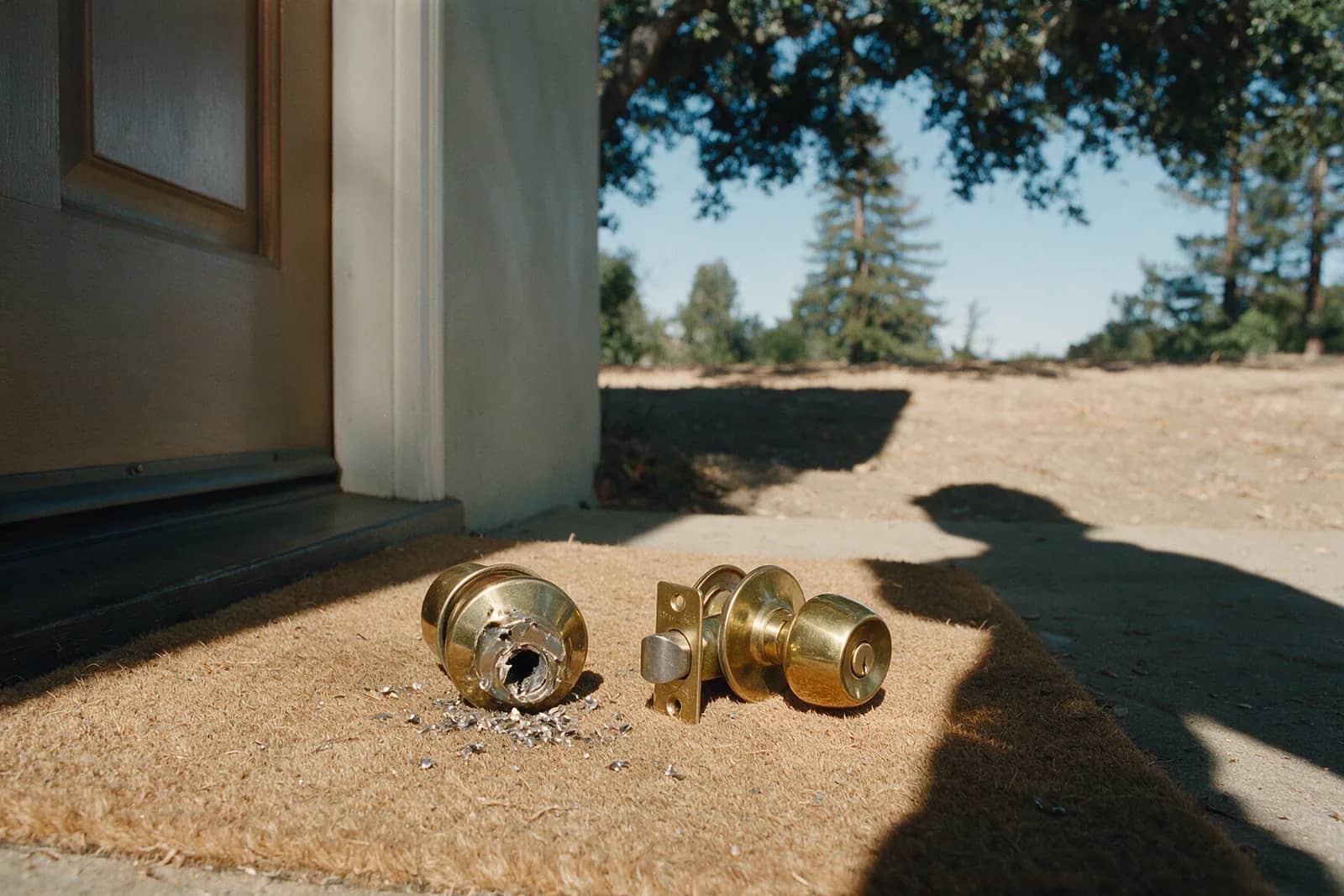
Why drilling is offered so readily
A drill opens almost any pin-tumbler lock in two minutes. A pick opens the same lock in five, or fifteen, or on a stubborn afternoon in twenty, and the difference is skill and patience that not every van carries. So a locksmith who is paid by the job and wants to be on the next one reaches for the drill, and then, because a drilled cylinder is scrap, sells a new lock to a customer who has no choice. The lockout was cheap on the phone; the lock that replaced it was not.
That is the arrangement the reader should know about before calling anyone. It is not dishonest in every case, and there are locks that deserve the drill. It is simply the wrong default for a city whose doors are, more than most, worth keeping as they are.
What a drill does to a Palo Alto door
On a Professorville mortise set the cylinder is set in a plate that was cast in 1915 and cannot be bought anywhere, and a drill that slips is a plate gone for good. On an Eichler the slab door is a thin sheet over a frame, and a drilled cylinder leaves a hole that a new lock will not cover cleanly. On the tall doors of a rebuilt house in Old Palo Alto a multipoint lock runs the height of the door, and drilling its cylinder can jam the gearbox that throws three bolts, which turns a lockout into a door that will not lock at all. On a high-security cylinder the drill may not go through at all; it will only ruin the cylinder and the afternoon.
Picked open, none of those doors knows the technician was there. The cylinder is rekeyed afterward if the keys are lost, at $27 to $45, or left alone if they are on the counter. That is the whole difference between the two methods: one ends the call with the door as it was, and the other ends it with a shopping list.
Five questions to ask on the call
First: is the figure said now, and does it include the visit and the hour? A locksmith who will only quote a starting number, or who says the visit is separate, has told you what the receipt will look like. Second: will the lock be picked first, and what happens if it cannot be? The answer should name drilling as a last step that needs your agreement. Third: if drilling does happen, does the figure for the lockout go up? It should not. Fourth: what hardware would be fitted if any is needed, and what grade is it? If the make and the grade cannot be named on the call, whatever is in the van is what gets fitted. Fifth: will the receipt itemize the visit, the labor and the parts, and will it match the figure said now?
None of those questions is rude, and each should get a one-sentence answer on the call. The answers are also worth having in a text before a van is sent, because a text is what you compare the receipt against.
What a straight answer sounds like
It sounds like this. A deadbolt and a knob on a ranch house in Midtown, keys inside, no one hurt, a quarter past nine on a weeknight: the figure is between $184 and $219 with the visit and the evening inside it, the lock will be picked, drilling is not expected and would be asked about first, no hardware is needed unless the keys are lost, and the receipt will show the same number by email while the technician is still on the porch. A text repeats it. The van leaves Midtown and a second text names the technician and the window.
What it does not sound like is a promise of a number that turns out to be a starting point, a lockout that becomes a new lock at the door, or a technician who arrives with a drill already in hand. Calls are answered 24/7, and the figure is said on the call, not at the porch.
When drilling is the honest choice
There are locks that leave no other way. A cylinder that has seized from corrosion on a low door near the creek, where the pins will not move for any pick. A cheap padlock on a shed that costs less than the minutes it would take to pick. A few high-security cylinders whose whole purpose is to resist picking and which are, by design, opened by their own key or by drilling. A safe whose lock has failed mechanically, where the honest opening is a small hole in a place chosen so the door can be repaired.
In each of those the rule is the same: the technician says at the door what would be drilled and why, what it would cost to replace afterward, and whether anything else can be tried first, and nothing happens until you agree. The lockout figure does not change. On a safe, opening is $195 to $539 and the repair of the hole is inside it. On a house, the replacement cylinder is $27 to $45 rekeyed or $125 to $329 for a new lock, and that line exists only because you chose it.
The Tall Tree Standard
Tall Tree Lock & Safe is a van based in Midtown, serving Palo Alto, Stanford and the towns beside them, and it works to a standard with four items. The lock is picked or decoded open first, and drilling happens only with your agreement and never for a higher figure. One figure is said on the call, covering the visit, the labor and the parts, and that figure is on the receipt. The hardware grade is named before it is fitted, and original hardware is kept and rekeyed wherever it can be. Payment is card or tap at the door, with an itemized receipt by email and a written line for a landlord, an HOA or an insurer when you need one.
Average arrival across Palo Alto is about twenty-two minutes, fourteen to twenty-five by district, and longer up Page Mill toward the hills or south to Los Altos, which is said on the call rather than discovered on the road. The old redwood by the creek gave the city its name; the standard is named for it because a tree that has stood that long deserves a house whose locks are treated the same way.
Quick answers
How do I know on the phone whether a locksmith will pick or drill?+
Ask whether the lock will be picked first, what happens if it cannot be, and whether the lockout figure rises if drilling is needed. A locksmith who names drilling as a last step needing your agreement, at the same figure, is answering honestly. Get the answer in a text.
Are there locks that really have to be drilled?+
A few: a cylinder seized by corrosion, a padlock not worth the time, some high-security cylinders built to resist picking, and a safe whose lock has failed. In each case the technician explains what would be drilled and what replaces it, and waits for your agreement.
If the technician picks the lock, do I need a new one afterward?+
No. A picked lock is unharmed. If the keys are lost the cylinder is rekeyed at $27 to $45. If the keys are on the counter nothing more is done.
Need it handled rather than read about?
(650) 252-1604More guides